
Laser tattoo removal works by directing controlled laser energy at tattoo pigment in the skin. The tattoo ink absorbs the energy and breaks into much smaller particles. Your body’s immune system then gradually clears these particles over time, causing the tattoo to fade between treatment sessions.
Removing a tattoo is a gradual process rather than something that happens in a single appointment. Ink color, tattoo size, location, depth, age, skin characteristics, and other factors can all affect how a tattoo responds to treatment.
At Future Skin Tattoo in Ottawa, we offer laser tattoo removal using PicoSure technology for people who want to fade or remove unwanted tattoos.
Quick Answer:
Laser tattoo removal uses concentrated light energy to target tattoo pigment beneath the surface of the skin. The energy breaks the pigment into smaller particles that the body can gradually clear through its natural immune processes.
Most tattoos require multiple treatment sessions. The number of sessions varies because every tattoo and every person’s response to treatment can be different.
Key Highlights
| Question | Quick Answer |
| How does laser tattoo removal work? | Laser energy targets tattoo pigment and breaks it into smaller particles that the body gradually clears. |
| Can a tattoo disappear after one session? | Usually not. Most tattoos require multiple sessions and gradual fading. |
| Are all tattoo colors equally easy to remove? | No. Different pigments respond differently to laser wavelengths. |
| Does tattoo size matter? | Yes. Size is one of several factors that can affect treatment planning. |
| Can every tattoo be completely removed? | Complete clearance cannot be guaranteed for every tattoo. |
| Does the tattoo fade immediately? | Treatment breaks down pigment, but much of the visible fading happens gradually afterward. |
Why Are Tattoos Difficult to Remove?
To understand tattoo removal, it helps to understand why tattoos last for so long.
When a tattoo is created, ink is deposited into the dermis, which is the layer of skin beneath the epidermis. Tattoo pigment remains in this relatively stable layer instead of simply washing or peeling away as the outer surface of the skin renews itself.
Your body responds to tattoo pigment as foreign material, but many pigment particles are too large to be efficiently cleared.
This is where laser tattoo removal comes in.
Instead of physically cutting the tattoo out of the skin, laser treatment targets the pigment and breaks it into much smaller particles. This gives the body’s natural clearance processes a better opportunity to remove some of that fragmented pigment over time.
How Does Laser Tattoo Removal Break Down Ink?
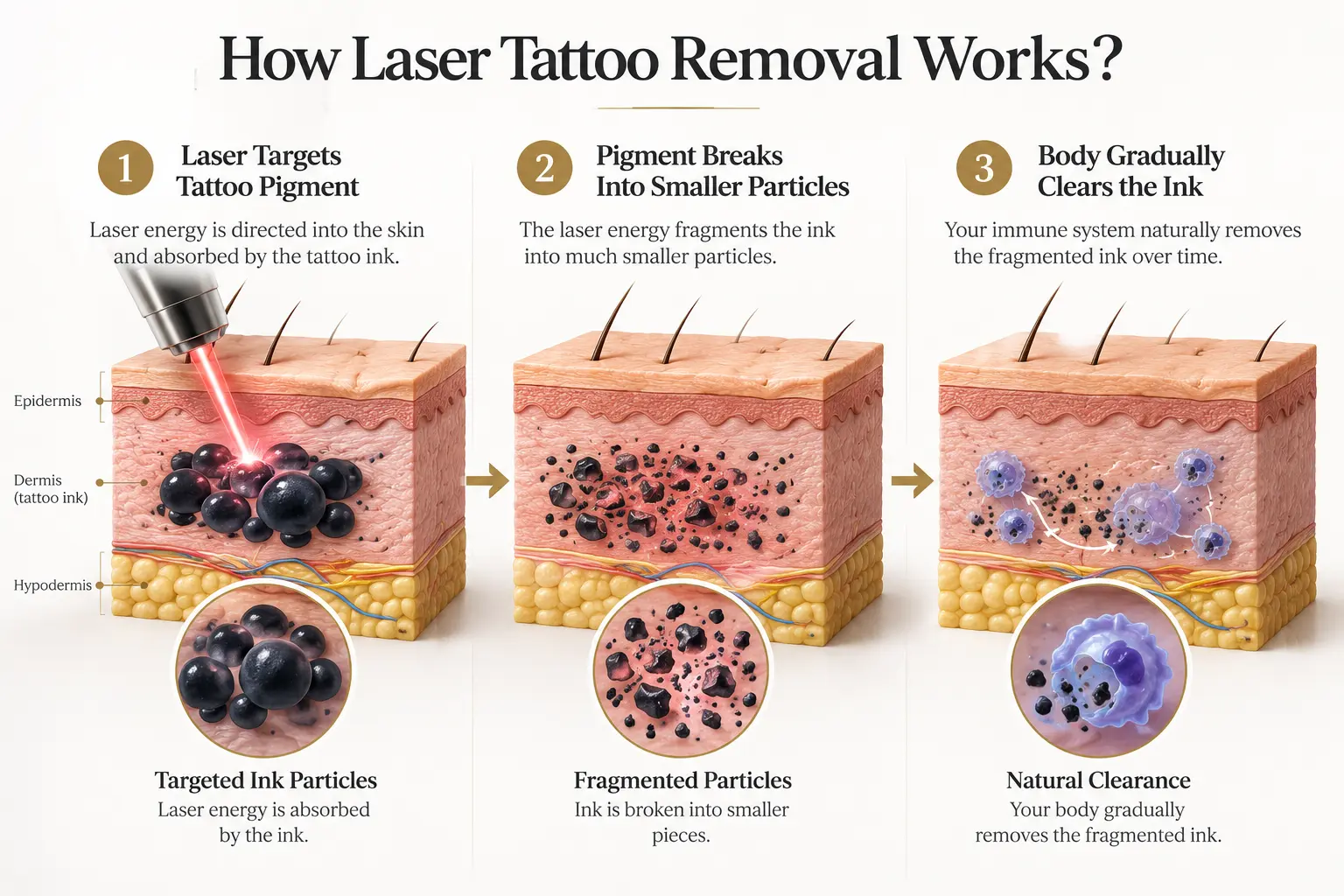
The process can be understood in four main stages.
1. Laser Energy Is Directed at the Tattoo
During treatment, laser energy is delivered to the tattooed area.
The goal is to target tattoo pigment while managing the effect on the surrounding skin. The appropriate treatment approach can depend on the tattoo, pigment colors, skin characteristics, previous treatments, and other individual factors.
2. Tattoo Pigment Absorbs the Energy
Tattoo pigments can absorb specific wavelengths of laser light.
Because tattoo inks come in different colors and compositions, they do not all respond identically. This is one reason a professional assessment matters before beginning a removal plan.
3. The Pigment Breaks Into Smaller Particles
When the targeted pigment absorbs sufficient laser energy, larger pigment particles are fragmented into smaller pieces.
Think of the process as breaking a large piece into increasingly smaller fragments rather than simply erasing the ink from the skin.
4. The Body Gradually Clears the Fragmented Pigment
The tattoo does not simply disappear when the laser touches it.
After treatment, the body’s immune processes gradually deal with the fragmented pigment. This takes time, which is one reason tattoo removal sessions are spaced apart rather than performed continuously.
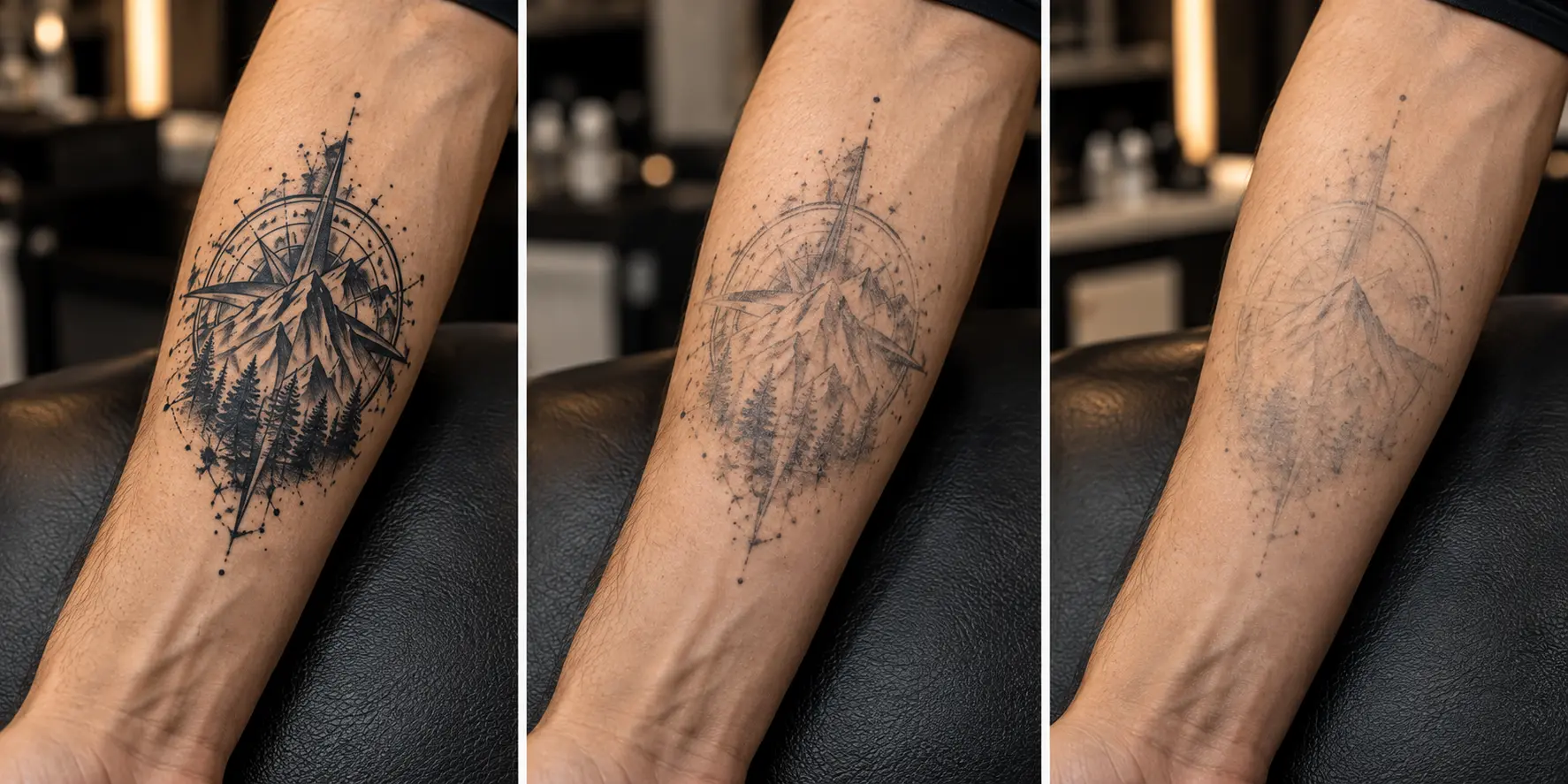
Over a series of treatments, additional pigment can be targeted and the tattoo may progressively become lighter.
What Is PicoSure Tattoo Removal?
At Future Skin Tattoo, we use PicoSure technology as part of our laser removal service in Ottawa.
PicoSure delivers energy in extremely short pulses. These rapid pulses are designed to target pigment and break it into smaller particles.
For someone considering tattoo removal, however, the name of the technology is only one part of the decision. The tattoo itself also needs to be considered, including its colors, size, location, age, density, and previous treatment history.
That is why an individual assessment is more useful than assuming every tattoo will respond in exactly the same way.
What Happens to Tattoo Ink After Laser Removal?
This is one of the most common points of confusion about tattoo removal.
The laser does not pull ink out through the surface of your skin.
Instead, the treatment fragments targeted tattoo pigment. The body then gradually processes and clears some of those smaller particles through its natural immune activity.
This process continues after you leave the appointment, which is why the appearance of a tattoo can continue changing between sessions.
Why Do You Need More Than One Laser Tattoo Removal Session?
A single session usually cannot target and clear all tattoo pigment.
Tattoo ink can exist at different depths and densities within the skin. A tattoo can also contain several pigments that respond differently to treatment.
Multiple sessions allow the tattoo to be treated progressively while providing time between appointments for the skin to recover and for the body to process fragmented pigment.
The total number of sessions is not identical for everyone.
Factors That Can Affect Tattoo Removal
Several characteristics can influence how a tattoo responds to laser treatment, including:
- Tattoo size
- Ink color
- Amount and density of pigment
- Depth of the tattoo pigment
- Professional or amateur application
- Tattoo age
- Tattoo location
- Skin characteristics
- Previous tattoo removal treatments
- Individual response to treatment
Because there are so many variables, estimates found online should not be treated as a guarantee for an individual tattoo.
Are Some Tattoo Colors Harder to Remove?
Yes. Ink color can have a significant effect on laser tattoo removal.
Different pigments absorb different wavelengths of light. Dark colors such as black and dark blue often respond more readily to commonly used tattoo removal wavelengths, while certain lighter or brighter pigments can be more challenging.
Multicolored tattoos can also be more complex because different colors may require different treatment considerations.
Ink composition matters as well. Two tattoos that appear to contain the same color may not necessarily contain identical pigments.
A professional assessment can therefore provide more useful information than judging a tattoo by color alone.
Does an Old Tattoo Remove More Easily Than a New Tattoo?
Tattoo age can influence treatment, but age should not be considered on its own.
An older tattoo may already have experienced some natural fading over the years. However, ink density, color, depth, placement, and individual factors still matter.
A newer tattoo also needs appropriate time to heal before removal is considered.
Rather than assuming that an old tattoo will always be easy to remove, it is better to evaluate the tattoo as a whole.
Can Laser Tattoo Removal Completely Remove a Tattoo?
Complete tattoo removal is possible in some cases, but it should never be guaranteed for every tattoo.
Some tattoos respond very well and become significantly lighter over a course of treatment. Others may retain visible pigment even after multiple sessions.
The final result can depend on ink color, pigment composition, depth, tattoo density, skin characteristics, tattoo location, and the way the individual responds to treatment.
A realistic treatment plan should therefore focus on your specific tattoo rather than promising a universal result.
What Happens to Your Skin After Laser Tattoo Removal?
The treated area can temporarily look and feel different after a session.
Redness, tenderness, swelling, soreness, and other temporary skin changes can occur. Your provider should give you appropriate care instructions based on your treatment.
It is important to follow those instructions and avoid unnecessarily irritating the area while it recovers.
Seek appropriate medical advice if you develop concerning symptoms, signs of infection, or a reaction that seems unusual or severe.
How Long Does Laser Tattoo Removal Take?
There are two different timelines to consider.
The treatment appointment itself may be relatively short for a small tattoo. The overall removal process, however, can take much longer because tattoos usually require multiple sessions with recovery time between treatments.
Trying to judge the total timeline based only on the size of the tattoo can therefore be misleading.
The more useful question is how your particular tattoo is likely to respond over a series of treatments.
Laser Tattoo Removal in Ottawa
Future Skin Tattoo provides tattoo, piercing, and laser removal services at 198 Rideau Street in Ottawa, Ontario.
Our laser removal service uses PicoSure technology, and our current pricing is based in part on the size of the treatment area.
If you are considering removing an unwanted tattoo or fading an existing tattoo for a future cover up, start by having the tattoo assessed rather than relying on a generic number of sessions.
You can learn more about our laser tattoo removal service in Ottawa or visit the Future Skin Tattoo to learn more about the studio and our services.
Thinking About Removing or Fading Your Tattoo?
Tattoo removal is not about erasing ink overnight. It is a process in which laser energy breaks tattoo pigment into smaller particles and your body gradually does much of the clearing afterward.
Understanding that process can help you set realistic expectations about sessions, fading, healing, and final results.
If you are in Ottawa and want to discuss an unwanted tattoo, Future Skin Tattoo offers PicoSure laser removal at our Rideau Street studio.
Want to know what removal could look like for your tattoo?
Book an appointment with Future Skin Tattoo and have your tattoo assessed before deciding on your next step.
Frequently Asked Questions
How does laser tattoo removal work in simple terms?
Laser tattoo removal sends controlled light energy into tattoo pigment. The pigment absorbs the energy and breaks into smaller particles. The body gradually clears some of these particles, allowing the tattoo to fade over time.
Does laser tattoo removal work instantly?
No. Although laser energy acts on the pigment during treatment, much of the visible fading occurs gradually as the body processes fragmented pigment. Multiple sessions are commonly required.
Where does the ink go after laser tattoo removal?
The laser fragments tattoo pigment into smaller particles. The body’s immune system then gradually processes and clears some of this fragmented pigment.
How many sessions does laser tattoo removal take?
There is no single number that applies to every tattoo. Tattoo size, color, ink density, depth, location, age, skin characteristics, and individual response can all influence the number of treatments required.
What tattoo colors are easiest to remove?
Black and other dark pigments often respond more readily to commonly used tattoo removal wavelengths. Some lighter and brighter colors can be more challenging. The actual response also depends on pigment composition and the laser being used.
Can one laser session remove a tattoo?
Complete removal after one treatment should generally not be expected. Tattoo removal is usually a gradual process involving multiple sessions.
Can you remove only part of a tattoo?
In some situations, laser treatment can be used to target a specific portion of a tattoo or fade areas in preparation for a new design. Suitability depends on the existing tattoo and treatment goals.
Is laser tattoo removal permanent?
Pigment successfully cleared from the treated tattoo does not simply regenerate as tattoo ink. However, complete clearance cannot be guaranteed, and some residual pigment or skin changes may remain.
Does laser tattoo removal leave a scar?
Scarring is a possible risk, but it is not inevitable. Tattoo removal can also cause temporary or lasting changes in skin color and other skin reactions. Individual risk should be discussed before treatment.
Can I get another tattoo after laser tattoo removal?
A new tattoo may be possible after the area has appropriately recovered. If your goal is a cover up, discuss this before beginning removal so the fading and tattoo plans can be coordinated.
Recent Comments